Gas vs Battery Weed Eater: Which Fits Your Yard? (November 2026)
Choose gas for thick growth, brush and long work sessions, or choose battery for quieter trimming with less routine care. Your yard size, cutting workload and access to charging matter more than the power source alone.
On this page (8 sections)
- Gas vs battery weed eater: which is stronger?
- Which option is better for a small yard?
- Which is better for a large yard?
- Gas or battery weed eater: which needs less care?
- How do runtime and fuel breaks compare?
- Which cutting width should you choose?
- How should you choose between these 4 tools?
- Gas vs battery weed eater: what is the final choice?
Choose gas for thick growth, brush and long work sessions, or choose battery for quieter trimming with less routine care. This gas vs battery weed eater comparison focuses on power, runtime, fuel care, cutting width and the type of work each tool suits.
Gas tools can keep running after you add fuel, which helps on large or overgrown properties.
Battery tools start with a charged pack and avoid fuel mixing, but the job is limited by battery capacity and the packs you have ready.
Your best match depends on the work, not just the yard's total square footage.
A small yard with thick brush may need more cutting strength than a larger yard with short grass and clean edges.
That is why power alone does not settle the choice.
The density of the growth matters as much as the size of the area.
Short, regular grass asks for control and easy handling more than raw strength.
Tall weeds, woody stems and tangled brush ask for a tool that can keep cutting through load without frequent stops.
Runtime also changes with the task you give the machine.
A narrow trimmer in light grass may work for a long stretch on one charge or tank.
The same tool in thick growth will use power faster and may need earlier refills or a battery change.
Access around your home matters too.
If you have a clear place to charge batteries and store packs safely, a battery model can stay ready for quick jobs.
If charging points are far from the work area, or the job is likely to run long, gas refueling may be simpler to plan.
Storage needs care either way.
Gas tools need proper fuel handling and engine care between seasons.
Battery tools need dry storage, clean contacts and packs kept within the maker's guidance.
Cutting width also shapes how the tool suits your yard.
Wider paths cover open ground faster, while narrower paths help around beds, trees and fences.
The right pick balances growth type, open space, detail work and how much upkeep you want to do.
Gas suits heavy and prolonged cutting.
Battery suits lighter routine care with quieter operation.
Use those habits, not just the label on the power source, to narrow your choice.

Gas vs battery weed eater: which is stronger?
Gas weed eaters have the clearest advantage for thick grass, brush and long cutting sessions. Battery models can handle routine grass and edging, but their usefulness depends on the battery system and the density of the growth.
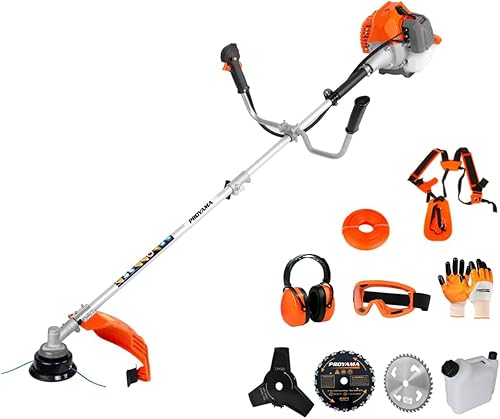
The PROYAMA uses a 42.7cc 2-cycle engine rated at 2HP. It has an 18 in cutting width and includes a trimmer head, 3T blade, 40T blade and chain blade.
The BILT HARD uses a 170cc 4-cycle OHV engine and clears a 22 in path. It is a walk-behind tool with a one-piece steel deck, 14 in never-flat wheels and a manual recoil start.
These are different gas tool formats. The PROYAMA is a handheld multi-purpose cutter, while the BILT HARD pushes through open overgrowth.
Neither is the natural choice for close, lightweight edging around a small lawn.
Gas power for grass, weeds and brush
The PROYAMA fits homeowners, gardeners and landscapers who need one tool for routine trimming and heavier clearing. The straight shaft reaches around fences, trees, sidewalks and other hard-to-reach areas.
Its cutting attachments change the work it can do. Use the trimmer head for grass and weeds, then choose an appropriate blade for denser vegetation while following the tool's assembly and safety instructions.
The BILT HARD makes more sense when the main problem is a wide strip of tall grass or light brush. Its 22 in cutting diameter covers more ground per pass, but its 54.1 lb weight makes it a poor fit for handheld detail work.
If the job has crossed into heavier vegetation, compare a clearing saw and brush cutter before choosing a string trimmer.
Battery power for routine lawn care
The BLACK+DECKER 20V MAX kit uses 2 included 1.5Ah lithium-ion batteries. Its 10 in trimmer converts to an edger, and the kit also includes a sweeper with a stated 130 mph air speed.
The BLACK+DECKER 40V MAX model has a 13 in cutting width and a power command dial. You can choose maximum strength for thick growth or favor longer battery life for larger areas, but the battery and charger are not included.
Battery power is a strong fit for grass around walkways, fences, garden beds and lawn edges. It becomes less suitable when the line repeatedly meets woody stems, heavy weeds or a large area that needs uninterrupted work.
Our guide to string trimmers and edgers explains the basic tool types and the jobs each one handles.
Which option is better for a small yard?
A battery weed eater usually fits a small yard better when the work is grass trimming and edging. Compare battery weed eater deals when you are ready to shop.
You avoid fuel preparation and can choose a compact tool with a narrower cutting width.
The BLACK+DECKER 20V MAX has a 10 in cutting width and a 4.5 lb trimmer. Its adjustable height and handle help you set a more comfortable working position, while the automatic line feed supplies line without bumping the head.
The kit includes 2 batteries and a charger, so it gives you a clearer starting point than the 40V bare tool. The sweeper also covers hard-surface cleanup after trimming.
Choose the 40V BLACK+DECKER if you already use that battery system or want its power command dial. Since the battery and charger are separate, check what you need before deciding that its tool-only format is the better value.
See our comparison of best string trimmer brands if brand support and battery systems are part of your choice.
Which is better for a large yard?
Gas is usually better for a large yard when the grass is thick or the job may run beyond one battery charge. Battery can still work well when the yard is open, growth is moderate and you have enough charged packs.
The PROYAMA combines cordless movement with a gas engine and an 18 in cutting width. Its 19 lb weight is higher than a small battery trimmer, but the shoulder straps, hip belt and broad back support distribute the load over a larger area.
The BILT HARD covers the widest path here at 22 inches. Use it when the main task is clearing a broad strip, fence line or rough area where pushing a wheeled machine is easier than carrying a handheld tool.
A large yard with many trees, beds and obstacles may favor the PROYAMA's reach and attachments. A large open area may favor the BILT HARD's wheels and wide path.
Gas or battery weed eater: which needs less care?
Battery weed eaters usually need less routine power-system care than gas models. You still need to manage line, guards and cutting parts, but you avoid fuel mixing and engine starting steps.
Gas care includes using the correct fuel mixture for a 2-cycle tool, checking the fuel system and following the starting procedure. The PROYAMA's guidance specifies a 40:1 fuel-to-oil ratio, so measure carefully rather than guessing.
The BILT HARD uses a 4-cycle engine, which is a different maintenance format from the PROYAMA's 2-cycle engine. Follow the correct manual for fuel, oil, storage and maintenance because the 2 engines don't use the same routine.
Battery tools still need basic care. Remove grass and debris from the guard and head, inspect the line or spool, and keep the battery and charger dry.
Store packs as directed by the manufacturer.
For a broader comparison, read gas vs electric weed eaters before deciding which type fits your maintenance routine.
How do runtime and fuel breaks compare?
Gas offers refueling continuity, while battery runtime depends on charged packs, cutting conditions and power settings. Neither fuel source gives one fixed runtime for every yard.
The PROYAMA can continue after a fuel refill, which helps when the work area is large or the grass is dense. Its 18 in width also reduces the number of passes compared with a narrower trimmer.
The 20V BLACK+DECKER includes 2 batteries, giving you a practical way to alternate packs during home maintenance. Its 10 in width and lighter format fit smaller trimming jobs rather than broad brush clearing.
The 40V BLACK+DECKER lets you adjust output with its power command dial. Use more power for thick growth and a lower setting when the area is larger and the growth is easier, while watching the battery level.
Don't compare voltage numbers as if they were direct runtime ratings. Battery capacity, tool load, line condition and the amount of growth all change how long the tool can work.
Which cutting width should you choose?
Choose a wider cutting path for open areas and a narrower path for careful work around beds, fences and obstacles. Width changes how many passes you need, but it doesn't replace the need for control.
The BILT HARD has the widest path at 22 inches.
The PROYAMA follows at 18 inches, while the BLACK+DECKER 40V model has 13 inches and the 20V model has 10 inches.
A wide path saves time along a straight fence line or open edge.
It can feel less precise around young plants, narrow gates and decorative borders.
A narrow trimmer takes more passes across open grass but gives you more control near obstacles.
The right choice depends on the ratio of open clearing to detail work in your yard.
Think about where most of your trimming happens.
Long, straight runs along a fence or driveway benefit from a wider sweep.
Each pass covers more ground, so you finish the open sections with fewer overlaps and less walking back over already cut growth.
That can matter on a large property or a boundary that has been left to grow thick.
Narrower widths suit tighter spaces better.
Around flower beds, steps, posts and low edging, a smaller head is easier to steer and less likely to stray into plants you want to keep.
You will make more passes, but each pass is more deliberate.
Dense growth also changes how width feels in use.
A wide handheld cutter in thick weeds can feel harder to guide, even if the tool is rated for the job.
A wheeled machine handles a wide path differently because the wheels carry the weight and help keep the line steady.
In that case, width is paired with push power rather than arm control.
For handheld battery models, the narrower widths here fit routine grass and edging.
The 10 inch trimmer will take more passes on open lawn edges, yet it remains easier to place near obstacles.
The 13 inch model balances coverage with control for larger home areas.
For gas handheld work, the 18 inch path covers more ground per pass for thick grass and brush clearing.
Set up for the width you choose by clearing the work area first.
Remove hoses, sticks and loose debris that could tangle with the line or blades.
Work in steady lines and keep the guard between you and the cutting head.
Keep the tool level and move at a pace that lets the line cut rather than forcing it through growth.
Slow down near boundaries and young plants, regardless of width.
A wider tool does not need to be used at full sweep in tight spots.
You can use part of the cutting path for detail work and reserve the full width for open runs.
That approach gives you both speed and care from the same machine.
Match the width to the yard you actually have, not the yard you wish you had.
If open clearing dominates, lean wider.
If detail work dominates, lean narrower and accept the extra passes.
How should you choose between these 4 tools?
Pick the PROYAMA for handheld gas power and brush attachments, the BILT HARD for wide push clearing, the 20V BLACK+DECKER for light home trimming, or the 40V BLACK+DECKER for adjustable battery output.
Start by marking your most common job. If you trim grass around the home once or twice a month, a battery trimmer may be easier to keep ready.
If you clear tall weeds along a long boundary, gas power or a wheeled trimmer may save time.
Next, check access. Handheld tools reach around trees and fences, while the BILT HARD needs a path wide enough for its 14 in wheels and a user who can safely push a 54.1 lb machine.
Finally, decide whether you want one tool for several cutting tasks. The PROYAMA's trimmer head and 3T, 40T and chain blades offer more cutting formats, while the battery models focus on trimming and edging.
Gas vs battery weed eater: what is the final choice?
Choose a battery weed eater for quieter routine trimming, simple startup and less fuel care. Choose gas when thick growth, brush, wide coverage or long work sessions are the main concern.
Pick the BLACK+DECKER 20V MAX for light home care with 2 batteries, a charger, edging and sweeping.
Pick the BLACK+DECKER 40V MAX when its power dial and 40V platform fit your setup.
Pick the PROYAMA for handheld gas power and several cutting attachments.
Pick the BILT HARD when a wheeled 22 in path is more useful than handheld reach.
If you're still deciding between the common names, our weed eater vs trimmer guide explains how the terms overlap and where the tool formats differ.
For gas starting options, see how electric start works on a gas weed eater.
Frequently asked questions
Is a gas or battery weed eater better?
A gas weed eater is better for thick grass, brush and long jobs without charging breaks. A battery weed eater is better for quieter home trimming with less fuel handling.
Compare your growth, yard size, storage space and access to charged batteries before choosing.
Does a gas weed eater have more power than a battery model?
Gas models here offer the strongest fit for demanding growth, with the PROYAMA using a 42.7cc 2HP engine and the BILT HARD using a 170cc 4-cycle engine. Battery models are better matched with routine grass, edging and lighter weeds.
Which lasts longer, gas or battery weed eaters?
A gas weed eater can keep working after refueling, while a battery weed eater must pause when its battery is depleted unless you have another charged battery. Runtime also changes with cutting width, grass density, power settings and how often you stop.
Are battery weed eaters easier to maintain?
Battery weed eaters usually avoid fuel mixing, carburetor care and fuel storage, so routine ownership can be simpler. You still need to inspect the guard, spool, line and battery contacts, then store batteries according to the tool maker's instructions.
What is the best gas vs battery weed eater for brush?
The PROYAMA 42.7cc gas model is the closest match for brush because it has 2HP, an 18 in cutting width and trimmer, 3T, 40T and chain blades. For broad areas, the wheeled BILT HARD has a 22 in cutting diameter and 170cc engine.


