Toro vs John Deere Zero-Turn Mowers: Which to Choose? (November 2026)
Choose between Toro and John Deere by matching the mower’s controls, deck options and local service support to your property. Compare specific models, since each brand sells different residential configurations.
On this page (9 sections)
- Toro vs John Deere Zero-Turn Mowers: Which Should You Choose?
- Toro vs John Deere zero-turn mowers: what should you compare first?
- Which brand fits your lawn and mowing route?
- How should you compare the controls?
- Which mower is easier to maintain and service?
- What should you check before buying either mower?
- How do you choose a cover for outdoor storage?
- How does Toro compare with other residential mower brands?
- Which should you choose: Toro or John Deere?
Toro vs John Deere Zero-Turn Mowers: Which Should You Choose?
Choose between Toro and John Deere by comparing the controls, deck choices and service access of the exact residential models you’re considering. The right mower depends on your lawn, gates, storage space and the support available near you.
A brand name alone won’t tell you whether a mower fits a narrow path or feels comfortable to steer. Compare specific models side by side, then check the owner’s manual for maintenance, towing and setup details.

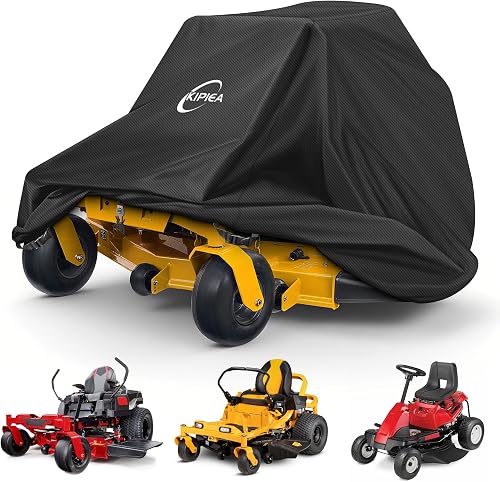 Best for buckle-secured storage
Kipiea Zero Turn Mower Cover- 600D Heavy
Toro vs John Deere zero-turn mowers: what should you compare first?
Start with the route you mow, the controls you can reach and the deck size your property can handle. These checks narrow the choice before you compare trim levels or accessories.
Measure the narrowest gate, shed door and passage between obstacles. Include room to turn, park and remove the mower for seasonal care.
Then look at each model’s control layout and seat adjustments. A mower can have the right deck width on paper and still feel like a poor fit if you can’t reach the controls comfortably.
Check local service access before deciding. Ask nearby dealers which models they service, what routine maintenance involves and how parts or repairs are handled.
Which brand fits your lawn and mowing route?
Choose the mower that fits your tightest passage and the open areas you mow most often. Property layout matters more than choosing a brand first.
A compact route with trees, beds or narrow gates puts a premium on turning room and mower width. A more open lawn may make a wider deck appealing, provided the mower fits through every access point and into storage.
Draw a simple map of your route and mark its narrowest points. Measure those openings, then compare them with each mower’s dimensions in the manual or manufacturer materials.
If small gates or limited storage are a concern, compare options in our guide to best small zero turn mowers. For a wider view of residential options, see our best residential zero turn mowers.
Does a wider deck always save time?
A wider deck can cover more ground per pass, but that advantage depends on the lawn. Obstacles, tight turns and trimming edges can reduce the time saved.
Check whether the wider mower can reach the entire area you plan to cut. A deck that cannot pass through a gate may require a second machine or a different route.
How should you compare the controls?
Compare how each mower’s controls sit in your hands and whether adjustments let you find a comfortable position. Control design and adjustment details can differ across models within the same brand.
Look for clear instructions on steering, speed changes, parking and safety interlocks. Read the operator’s manual before use so you know how the mower responds and how to stop it safely.
If a dealer has the models in stock, sit in each one and check whether the handles fall naturally within reach. Confirm that your knees, feet and hands have room through the full control movement.
Don’t judge comfort from a photo or brand reputation. Your height, reach and preferred seating position affect whether the controls feel manageable.
Which mower is easier to maintain and service?
Choose the model with a clear maintenance schedule and service support you can reach. A nearby service option can matter when routine care or a repair takes the mower out of use.
Compare the maintenance sections in both manuals. Check how each manufacturer describes cleaning, blade care, belt inspection, lubrication and engine servicing for the exact model.
Ask a local dealer whether they service both brands and what information they need to identify replacement parts. Confirm service hours and pickup arrangements if transporting a mower would be difficult.
Keep the manual and model number with your maintenance records. That makes it easier to follow the right schedule and ask specific questions later.
What should you check before buying either mower?
Verify the exact model’s dimensions, safety features, maintenance needs and permitted attachments before you decide. Similar-looking mowers can have different equipment and instructions.
Confirm that the mower fits through your route and into its storage spot. Measure the full opening, then allow practical room for turning and parking.
Review the safety instructions and identify any features you need to use safely. Follow the manual for starting, stopping, slopes, mowing conditions and protective equipment.
Check whether the mower supports the accessories you want. For towing, use only an approved hitch and follow the mower’s stated limits.
Can an aftermarket hitch fit either brand?
The HOWBOW hitch is described as compatible with many mower models, including Toro and John Deere. Its mounting slots fit 2–5.1 inches of bolt spacing, so measure the mounting points and confirm the mower manual permits towing before choosing it.
Compatibility claims don’t confirm fit on every model. Check the hitch position, hardware and towing instructions for the exact mower before installation.
How do you choose a cover for outdoor storage?
Match a cover to the mower’s dimensions and deck size, then check how it fastens. A cover that is too small can leave parts exposed, while an oversized one may be harder to secure.
Measure the mower with any attachment that will remain in place. Compare the height, length and width with the cover dimensions, and follow the cover’s directions for securing it.
The Kipiea cover measures 79 x 55 x 46 inches and has four buckles, two drawstrings and a storage bag. The Rimwig cover measures 203 x 117 x 140 cm and uses elastic bottom straps.
For a mower with a deck up to 62 inches, the Porch Shield cover is sized at 83 x 62 x 50 inches. It also has an air vent, elastic hem and buckles.
How does Toro compare with other residential mower brands?
Use the same checks for every brand: route fit, controls, deck choices and service access. A consistent comparison helps you avoid choosing by name alone.
If you’re also considering Cub Cadet, compare the exact Toro and Cub Cadet models in our Toro vs Cub Cadet zero turn mower comparison. Look at mower dimensions and equipment before comparing brand reputations.
You can use the same approach for a Husqvarna vs Ariens zero turn mower comparison. Check which brand has service support near you and whether its model fits your property.
Which should you choose: Toro or John Deere?
Choose Toro or John Deere by selecting the specific mower that fits your route, feels manageable and has service support you can use. Pick the model with the deck and controls that suit your property, then confirm its maintenance and accessory rules in the manual.
A narrow gate or shed opening may rule out a wider mower, regardless of brand. A comfortable control position and a nearby service option can matter more than small differences in advertised features.
Before buying, measure access points, sit in the mower if you can and compare the manuals. That gives you a practical answer to the Toro vs John Deere zero-turn question for your lawn.
Frequently asked questions
Which is better, Toro or John Deere zero-turn mowers?
Neither brand is the best choice for every lawn. Compare the exact mower’s control layout, deck width, available accessories and service options near you.
A smaller deck may suit gates and tight areas, while a wider one may reduce passes on open lawn, if your storage and route can accommodate it.
Are Toro and John Deere zero-turn controls different?
Controls vary by model, so compare the specific mower rather than assuming every Toro or John Deere feels the same. Look at the steering controls, seat position, adjustment options and control placement in the manual or at a dealer.
If possible, sit in the mower before buying to check reach and comfort.
How do I choose a zero-turn mower deck size?
Choose a deck that fits the narrowest gate, path and storage opening you need to pass through, then consider how much open lawn you mow. A wider deck can cover more ground in a pass, but only if it fits your route and storage space.
Check the mower’s full dimensions, not deck width alone.
Can I tow a cart with either mower?
Only tow a cart if the manual for your exact mower permits it and specifies a compatible hitch and load. The HOWBOW hitch is designed for several mower brands, including Toro and John Deere, but universal fit language does not replace checking your mower’s mounting points and towing limits.
How should I protect a zero-turn mower in outdoor storage?
Choose a cover that matches the mower’s full dimensions and deck width, and secure it as directed. The Porch Shield cover is sized for decks up to 62 inches, while the Kipiea and Rimwig covers have their own stated dimensions.
Remove or account for attachments that change the mower’s outline.


